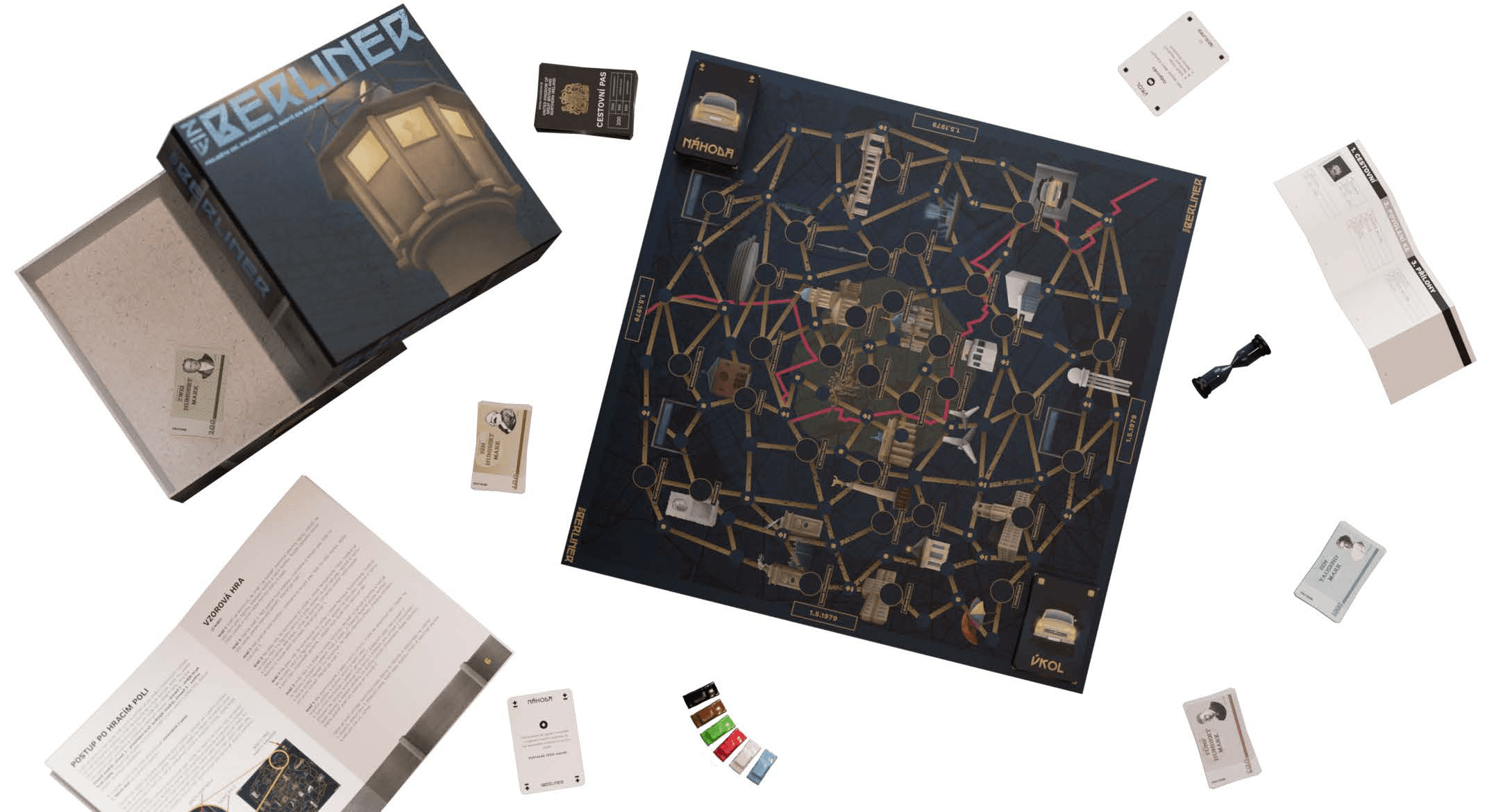
An original board game inspired by Papers, Please!, set in the era of divided Berlin.

The project came out of my very first term project at the Creative Communication University (VŠKK), led by Martin Strnad from the HMS Design studio. The brief was clear: build a functional board game from scratch.
We drew inspiration from the atmosphere of successful indie video games (e.g. Papers, Please!) and set the story in the historical setting of East and West Berlin. Playing as border guards, players had to check passports under time pressure, spot errors, answer historical questions, and complete tasks. The result was a fully playable board game with its own cards, currency, board, and rules.
User/market problem: At the time, the board-game market lacked titles that would bring the specific, tense mechanics of popular computer simulators (like the constant checking of documents and decision-making under pressure) into a physical, tabletop form.
The challenge: Create a mechanically balanced yet visually attractive game in just one month — one that draws players into the specifics of the Cold War and holds their attention.
In a four-person team of graphic designers I held a key dual role:
Game Designer (co-author of the mechanics): I designed and conceived the complete logic and mechanics of the game, the passport-checking principles, and the structure of the rules.
Graphic designer: I was in charge of the complete visual design of the in-game currency and the typesetting and layout of the rules for both the paper prototype and the final presentation.
Development ran in two intense phases:
Phase 1 (the term month): In one month we had to devise and produce the first version of the rules, test the core mechanics, and draw the complete graphics. Our concept impressed the Graphic and Media Design (GMD) studio so much that our supervisor helped arrange a meeting with the publisher Albi.
Phase 2 (iteration and final prototype): We got another 14 days to prepare. We made a radical decision — we kept only the working mechanics and rules, but redrew all the graphics from scratch. We had a professional physical prototype produced and, under Martin Strnad's guidance, prepared to pitch to publishers from Albi and then Dino.
The result is a fully playable board game with its own cards, in-game currency, board, and rules. For the final pitch we had a professional physical prototype produced with completely redrawn graphics, which we presented directly to publishers.
Although the project was originally meant "just" as school work, it gained an unexpected commercial reach:
Academic impact: The work was rated very highly in the VŠKK studio for its originality and the complexity of its execution.
Real business reach: We got the unique chance to present the complete concept and physical prototype directly to representatives of the largest Czech board-game publishers — Albi and Dino.
A commercial lesson: The game ultimately didn't go into production. From the perspective of experienced publishers, its core mechanics turned out to be somewhat dated and the market demanded a different kind of gameplay. But it was invaluable feedback straight from the industry.
What I learned: It was my first big test in designing a complex product from scratch under time pressure. I learned to think not only about graphics but above all about the user experience of play and how rules shape people's behavior at the table. I also gained priceless experience pitching my own idea to major market players (Albi, Dino) and understood how vast the gap can be between a "nice idea" and a real product ready for the mass market.
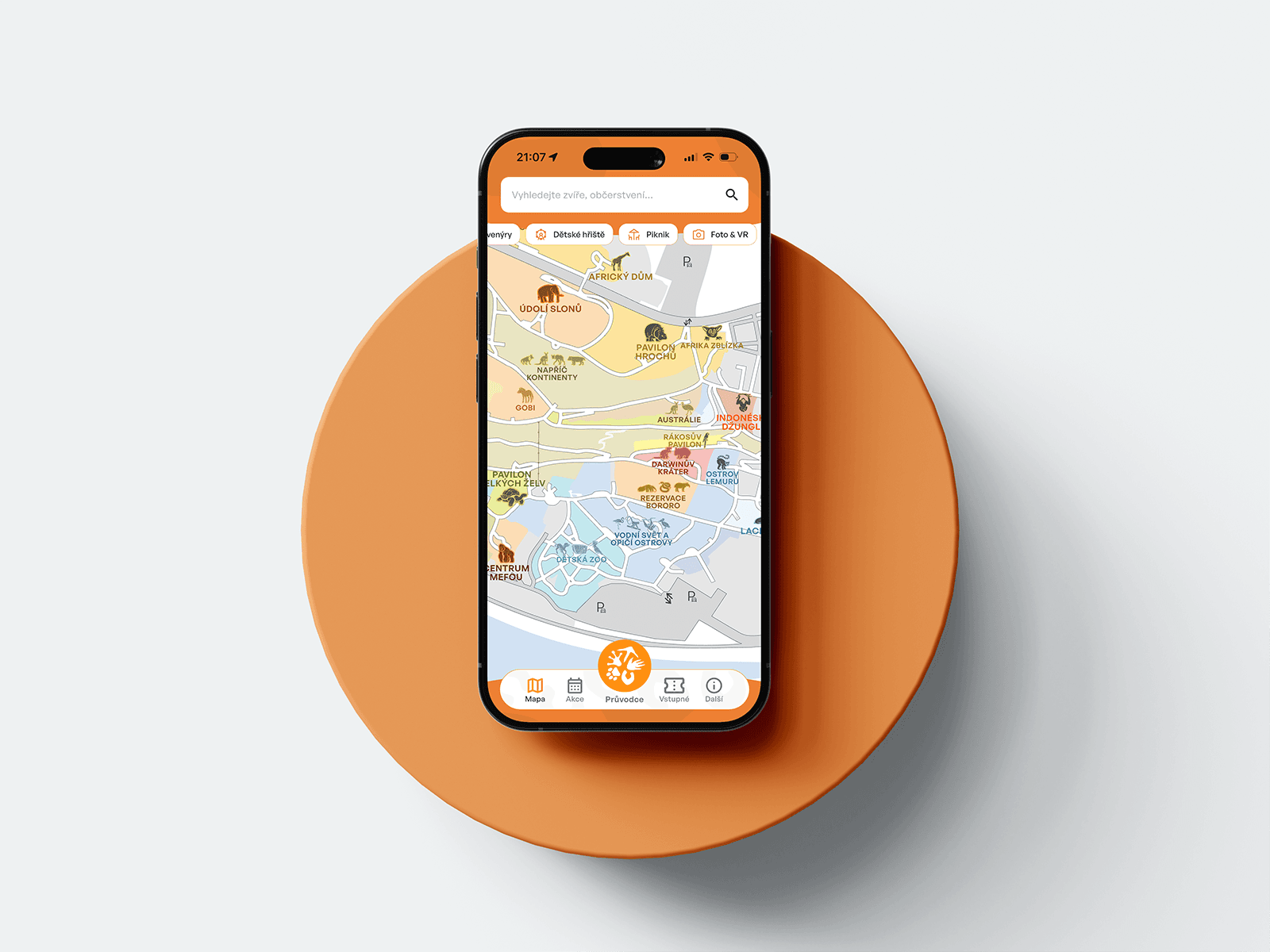
A mobile guide to Prague Zoo — interactive map, ticket sales, animated onboarding.

Gamifying Škoda Auto's corporate strategy as a 3D open-world game.

A robust company-management system with a connected B2B/B2C e-shop for catering.

An original board game inspired by Papers, Please!, set in divided Berlin.

An anniversary packaging edition for an iconic cheese brand that won the competition and reached shelves across Czechia.

A concept mobile financial coach built on conversational AI, turning passive banking into proactive money management.

A complete visual identity and brand manual for a student tech community running hackathons and workshops.

A website redesign for a traditional garden centre — clear presentation of products, services, and live info, fully responsive.

Turning a technical prototype into a market-ready product — a cohesive visual identity built to scale to web.